Bruce Lee was born in San Francisco, California, and he grew up in Hong Kong until his teens. His films produced by Hong Kong and Hollywood produced traditional to modern Hong Kong martial arts films, sparking a surge of interest in Chinese martial arts. The direction and tone of his films changed and influenced martial arts and martial arts films in Hong Kong and around the world. Lee became an iconic figure, especially for the Chinese and he became China's national pride in his movies. He mainly practiced Chinese martial arts (Kung fu), particularly Wing Chun.
Untold Mystery Around Vatican City
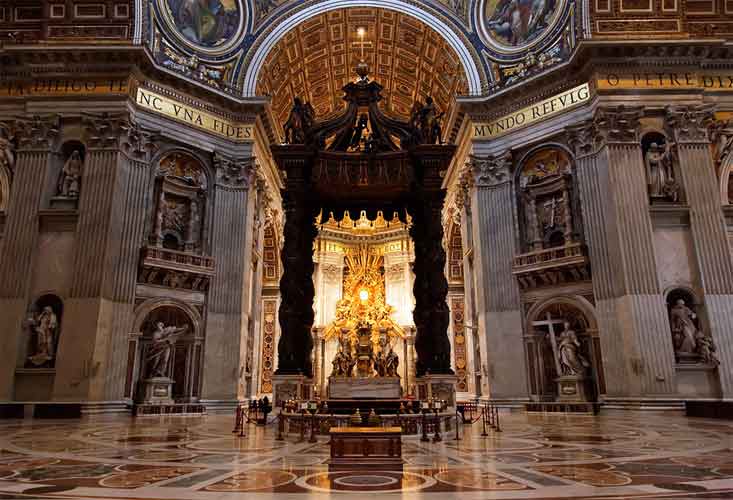
The Vatican is the most sacred worship center for Christians, this is where their leader called the Pope resides. This place is like a Qibla if in Muslim. Vatican City or in Italian Città del Vaticano is the smallest country in the world which has an area of only 44 hectares, located within the State of Rome, Italy. Although the population there is quite small, around 1000 people, every religious holiday, this place is always crowded with people from all over the world, whether they want to worship or just for a spiritual tour.
The magnificent and classic building is a special attraction and the atmosphere of ancient Catholicism is very thick there. Of course, all antiques always hold a mystery, and this Vatican site is no exception. For that, let's look at the mystery that surrounds the Vatican below, compiled from various sources.
1 | Sedes Sacrorum
2 | Pope and Dagon
3 | St. Peter's Tomb
4 | The Creation of Adam Painting
5 | Obelisk
Makara, the Mythological Creature of Borobudur Temple
Makara is a mythological monster from India, a half-crocodile fish that can also be found within the Borobudur temple in Indonesia. Makara has been characteristically depicted as half mammal and half fish. In many temples, it is depicted as a half-fish or a seal with an elephant's head. It is also shown in anthropomorphized (abstract) form with the head and jaws of a crocodile, the trunk of an elephant with fish scales, and the tail of a peacock.
As a sea creature, it may have begun as a crocodile, but its iconographic form becomes more and more distant from the actual experience of marine or deep water animals. The Makara statue that serves as a water spout in the ninth-century Borobudur Buddhist temple is an elephant, with four unusual cheek teeth that more closely resemble the fossils in the got hoot of the Asian elephant (Elephas maximus).
According to Wikipedia, 'Makara' is a Sanskrit word meaning "sea dragon" or "water monster". In Tibetan it is called "chu-srin", and also denotes a hybrid creature. This is the origin of the Hindi word 'crocodile', (magar), which was later lent to English as the name of the Mugger crocodile, the most common crocodile in India.
Guided by the god Vishnu, Makara is sometimes depicted as a crocodile, dolphin, crab, shark, or half fish and half elephant.
Josef Friedrich Kohl of the University of Würzburg and several German scientists claim that the Makara is based on the Dugong, based on a reading of the Jain text of the Sūryaprajñapti. The 26th-century Tibetan Bronze Makara closely follows the traditional description. A crocodile's jaw with pointed teeth, fish scales, a peacock's tail, an elephant's trunk, a monkey's eyes, and a boar's tusk. In astrology, the Makara is often translated as the Water Horse and corresponds to the western astrological sign of Capricorn. It's serpentine or seal-like, the elephantine head is often used as architectural decoration or as a structural bracket.
In Hindu mythology, the Makara is also an emblem of the Kama, the god of love who directs the honey bows of his bees that allow the flower of love to fly. A possible explanation is Tetralophodon, an advanced Gomphot here that lived in India and Java in the Pliocene epoch, 5 million years ago, and survived in history.* The Makara myth may be partly based on the Nile crocodile (Crocodylus niloticus) and Hippopotamus (Hippopotamus amphibius).
3 Ways to Play Jelangkung Indonesia's Most Terrifying Spirit Game
Jelangkung is known as a mystical game that is said to bring in spirits or demons. The spirit will communicate through the medium provided by the player. Why does it have to be through the media? Because ghosts and humans have different dimensions, they do not necessarily communicate or make sounds directly but through the media that the spirit communicates with humans.
If you don't understand dimensions just watch the movie "Interstellar" which tells the story of an astronaut who is trapped in a higher dimension in a black hole. He tries to communicate with someone on Earth using signs such as watch movements, falling books, and even dust that forms morse code.
They are not limited by time and space but cannot interact directly due to the different laws of nature. This is how higher dimensional beings try to communicate with humans. If we successfully play the Jelangkung game, there will be inter-dimensional interaction.
In Indonesia, the Jelangkung game is identical to a wooden doll with clothes and coconut shells and a pencil underneath. When playing the doll will automatically write down what we ask. Maybe this method is very complicated for those of you who want to play it immediately. For that, here are some ways to play Jelangkung that are easy to practice. The technique below comes from a foreign country which is also similar to the game of Jelangkung.
6 Mysteries and Myths of Mt. Gede Pangrango
The people in Bogor and Jakarta who are frequently traveling to Puncak Bogor, they absolutely familiar with this mountain. Yes, that's Mount Pangrango, one of the mountains that offer stunning natural beauty. This mountain, which has an altitude of 3,019 meters above sea level, is the second highest mountain in West Java after Mount Ceremai.
Next to it is Mount Gede and this area is included in the Mount Gede Pangrango National Park. It contains forests that contain ecosystems of flora and fauna that are protected and preserved. Not surprisingly, many people choose to unwind in this cool area.
With so many forests and dark areas, this area is often considered haunted and has many mysteries. In fact, some of them are often experienced by hikers and local residents. A very mysterious nonsensical phenomenon that is always associated with the existence of supernatural beings.
Like other mountains, Mount Gede Pangrango also has mysteries that are worth listening to, regardless of whether the story is genuine or not. Here are some mysteries collected from several sources.
The Mystery of the Monster Who Owns the Number 666
The connection between the number 666 and the Antichrist is based on the book of Revelation chapter 13 verse 18 where John the Revelator is told in his apocalyptic vision that the number of the Beast is 666 and that this number indicates a person. In John's first century world, the Beast ruling the Earth would be the emperor, the Roman emperor, Nero (37 C.E.-68 C.E.). Using the Hebrew alphabet, the numerical value of "Caesar Nero," the merciless persecutor of the early Christians, is 666. Although Jesus (chapters 6 BCE-30 CE) made it clear when speaking to the apostles that no one would know the exact hour or day of His Second Coming, for centuries certain Christian theologians have attributed the rise of the Antichrist to his seven years of power and accomplishments throughout the earth as a kind of catalyst that will set in motion the battle of Armageddon, the final battle between good and evil, a final clash between the armies of Jesus Christ and Satan.
Since the Protestant Reformation, the pope has become a favorite of certain Evangelicals because of that outrageous title. Many of the popes in the Middle Ages exercised great power over the rulers and people of the emerging European nations; and as a result, there were many angry princes and fiery Protestant leaders who sought to dissolve the faults of a large number of repressive social and religious programs in the Vatican.
However, contemporary popes have little political influence, certainly nothing that would put them in a position to threaten the world. There are those like Aleister Crowley (1875-1947), who actually seemed to covet and campaigned for the position by calling himself the Beast and 666. Hollywood has capitalized on the fascination of certain Christians and horror movie fans with the terrible evil of the Antichrist and portrayed him in a number of films. In Rosemary's Baby (1968), an unsuspecting young wife (Mia Farrow) is chosen to give birth to the Antichrist after her husband (John Cassavetes) makes a pact with Satan.
The Omen (1976) made three series of films that followed the Antichrist from childhood to his rise to wealth, power, and charismatic mastery as an adult. In this first of these films, Gregory Peck, as the Antichrist's unsuspecting surrogate father, is warned of his son's true identity by a number of priests and others who are all given advance warning as the reproach of madmen, he is then shocked to find the number "666" on his son's scalp and he resolves to do whatever must be done to stop Satan's will from being carried out.
Despite valiant efforts on the part of the father, who now correctly concludes that His true son was killed and replaced by disciples of the Antichrist, the demon seed continues its destructive path to world domination in two additional movies.
In The Chosen (1977), Kirk Douglas plays another oblivious father, an industrialist specializing in building nuclear power plants, who realizes that his son (Simon Ward) is the Antichrist. In Lost Souls (2000), a pious teacher played by Winona Ryder must convince a young journalist that he is the Antichrist before the fateful moment when the awakening of his new evil consciousness will take hold of his mind. Arnold Schwarzenegger is challenged by the almost impossible mission of preventing Satan (Gabriel Byrne) from fathering the Antichrist in Last Days (2000).
In Stigmata (2000), Byrne switches sides and plays a priest who struggles to thwart Satan's interference with a young stigmatist, a woman suffering from the bleeding wounds of Christ's crucifixion. Bless the Child (2000) depicts a desperate mother (Kim Basinger) who must somehow prevent her specially gifted and blessed child from becoming the human sacrifice that will give the Antichrist his full opportunity to enter the world.
The Mystery of the Giant Octopus "Kraken", Does it Exist?
The sea has a million mysteries, especially underwater creatures that rarely appear on the surface. It is very possible that there are many underwater species that have not been recorded, considering that the depth of the sea, especially in the sea passages or troughs, is very difficult to reach and has not been mapped in its entirety. After all, no one can dive at such depths, as the depths can be tens of kilometers, the deepest recorded dive ever made by humans is only 330m.
However, some have dived to greater depths than that using James Cameron's Vertical Torpedo. They managed to enter the deepest trough on Earth, the Mariana Trench. But only half of the total depth of the Mariana Trench can be up to 10 kilometers deep. Even the true depth is still mysterious. That means there are still many strange creatures and perhaps giant ancient beings sleeping in the sea.
Sailors have long told stories about the existence of giant underwater creatures, one of which is a giant octopus nicknamed the Kraken. The Kraken is a legend of a giant underwater creature, which is said to live on the coasts of Norway and Greenland. Many stories describe this giant octopus measuring 12-15 meters long with a thin membrane and a scary face. The legend of the Kraken was first introduced by Dane Erik Pontoppidan in 1752.
Kraken comes from the Norwegian Krake, which means unhealthy animal or something that writhes, while in German, Krake means octopus, which could also refer to the mythological creature Kraken.
In the late 13th century, there is a story of a journey to Helluland that passed through the Greenland sea. On the way, they saw 2 giant creatures named Hafgufa and Lyngbakr. Hafgufa is believed to be related to the Kraken creature. Here's the quote:
Now I will tell you that there are two sea monsters. One is called Hafgufa, and the other Lyngbakr. Lyngbakr is the largest whale in the world, but Hafgufa is the heaviest monster in the sea. This is the nature of these creatures, they like to swallow men and boats, even whales and everything within their reach. They stay submerged for days, then pop their heads and nostrils above the surface and stay that way at least until the tide changes. Now, all we have passed is the distance between its jaws, and its nostrils and lower jaw are the rocks that appear in the sea, while Lngbakr is the island we saw sinking.
However, Ogmund Tussock has sent these creatures to you by using his magic to cause the death of you and your companions. He thinks more men will go the same way as those who have drowned [that is, to Lyngbakr which is not an island, and drown], and he predicts that Hafgufa will swallow us all. Today I am sailing through his mouth because I know that it has just appeared.
After returning from Greenland, the author of the Old Norwegian scientific work Konungs skuggsjá (1250) describes in detail the physical characteristics and feeding behavior of these animals. The narrator proposes there should be only two in existence, according to which, according to observations, the animals are always seen in the same part of the Greenland Sea, and each of them seems to be incapable of reproduction since their number does not increase.
There is a fish still unmentioned, which it is not advisable to talk about because of its size and people would consider it an outlier. There are few people who can say it clearly, because it is rarely near land and is not seen where whales are seen, and I don't think there is much fish of this type in the sea. Most often in our tongue, we refer to it as Hafgufa ("Kraken", for example, Laurence M. Larson's translation).
I also cannot conclusively speak of its length in ells, because the times it has appeared before humans, it has looked more earth-like than fish-like. Nor have I ever heard of one being caught or found dead; and it seems to me as if there could not be more than two in the ocean, and I take it that each cannot reproduce itself, for I believe that they are always the same. Nor, then, would the fish do so if the Hafgufa were like other whales, because of their great extent, and how much they require.
It is said to be the nature of this fish that when it wants to eat, then it wraps its neck with a big burp, and after burping, a lot of food comes out, so that all kinds of fish close to its hand will approach it, then gather together, small and large, believing that they will get their food and good food. But this big fish leaves his mouth temporarily open, and the gap is no less wide than that of a sound or a good bundle, nor can the fish run together there in large numbers. But once its stomach and mouth are full, then this creature locks its jaws and the fish is caught and closed, that is before the glutton comes there looking for food.
Swedish writer Jacob Wallenberg described the Kraken in 1781 in Min Son På Galejan ("My son in the kitchen"):
The Kraken also called a crab fish, which is not so big, since the head and tail are counted, he is no bigger than the width of our Öland (less than 16 km)... He lives at the bottom of the sea, constantly surrounded by innumerable small fish, which serve as his food and are fed by him in return. His feeding, (if I remember correctly what E. Pontoppidan wrote,) lasts no more than three months, and another three are then needed to digest it.
His feces raise the following children less fish, and for this reason, fishermen climb his resting place. Gradually, the Kraken rose to the surface, and when he was ten to twelve years old, the ships had moved better than the surroundings, because he would soon afterward explode, like a floating island, spouting water from his monstrous nostrils and making waves all around him, which could reach tens of miles. Could anyone doubt that this was the Leviathan of Job?
In 1802, French malacologist Pierre Dénys de Montfort recognized the existence of two types of giant octopus in Histoire Naturelle Générale et Particulière des Mollusques, an encyclopedic description of mollusks. Montfort claimed that the first type, the Kraken octopus, had been described by Norwegian sailors and American whalers, as well as ancient writers such as Pliny the Elder. The second, much larger type, the colossal octopus, was reported to have attacked sailing ships from Saint-Malo, off the coast of Angola.
Montfort then dared to make more sensational claims. Ten British warships, including a captured French ship of the line Ville de Paris, which mysteriously disappeared one night in 1782, must have been attacked and sunk by a giant octopus. The British, however, took thanks from survivors of the Ville de Paris, who said that the ships had been lost in a storm off the coast of Newfoundland in September 1782. This was a humiliating blow to Montfort.
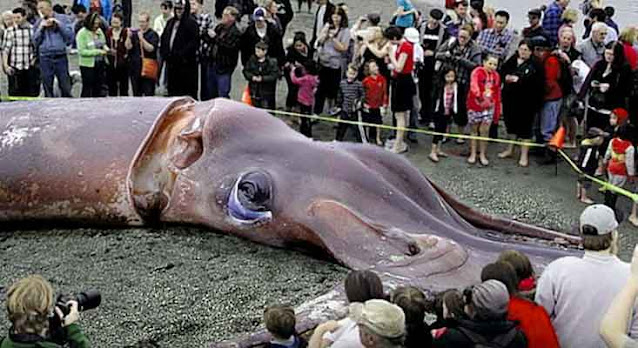
In the modern world, this kind of creature does exist. According to the BBC website, this creature is called Architeuthis dux, which is known as the largest squid specimen that appeared in 1639 in Europe. Since its discovery, there has been much debate about the maximum size of the animal. In solving the mystery, Dr. Chris Paxton from the University of St. Andrews, Scotland has researched Architeuthis dux how and what its maximum size is.
A total of 460 specimens were measured in different methods. Since none of the measurements were accurate, he calculated it based on the size of the squid's beak and mantle. Based on his measurements, the squid that washed ashore in Cook Strait in New Zealand in May 1879 was 14.28m long, but the maximum size is uncertain due to the changing body proportions. According to him, a squid with a mantle length of 2.79 meters would have a total length of between 5.83 meters and 27.53 meters. Due to the uncertain proportions, it is very likely that many squids larger than that are hiding under the sea.
Read also 11 Funny Fact About South Korea
Unsolved Mystery of Dinosaur Extinction
Dinosaurs became extinct at the end of the Cretaceous Period. Experts are still confused about what caused their extinction. Some believe the extinction was caused by such as a meteorite or comet hitting the earth and others believe more gradual processes should be responsible, such as competition between mammals and dinosaurs, or severe climate change. We're also not sure how long it took for the extinction to occur. Some believe it happened over half a million years and others say it only took a few days. The extinction event that killed the dinosaurs affected the whole earth! Plants and animals on land and water were affected. The loss of other living things was so great that scientists knew about the extinction 30 years before the first dinosaur was discovered.
Victims of the Cretaceous extinction included dinosaurs, ammonites (mollusks related to octopuses, and chambered nautiluses), pterosaurs, and certain groups of plants. But many other animal groups, such as mammals, turtles, crocodiles, salamanders, toads, birds, snails, bivalves, starfish, and sea urchins. Even some groups of large-bodied reptiles, such as Champsosaurs, were not affected. The idea that the dinosaurs have passed and left the world of shrew-like mammals and cold-blooded reptiles is wrong. On the contrary, many modern land animals have taken up residence in the Cretaceous.
Dinosaurs shared with modern creatures in the last millions of years. Because more than just dinosaurs went extinct, reasons that only explain why dinosaurs died out can be ruled out. For example, there is one theory that disease caused the extinction of dinosaurs. But disease could not have caused the extinction of plants and animals all over the world. There are two groups of extinction theories: catastrophic extinction and gradual extinction. Catastrophic extinctions would be caused by a sudden external event, such as the earth colliding with an asteroid, or the eruption of a series of giant volcanoes. Gradual extinctions would be the result of changes in land mass and climate shifts. It could also be because new and improved animals won in the struggle for existence.
The space asteroid collision theory stems from the discovery of layers of rock dated precisely to the extinction event, and rich in the metal iridium. These layers are found all over the world, on land, and in the oceans. Iridium is rarely found on Earth but is found in meteorites at similar concentrations as in these layers. This has led scientists to postulate that iridium was scattered around the world when a comet or asteroid struck somewhere on Earth and then vaporized. The 110-mile (180-kilometer) crater carved into Mexico's Yucatán Peninsula, named Chicxulub, dates back 65 million years. Many scientists believe this crater occurred during the extinction of the dinosaurs.
But the Earth's core is also rich in iridium, and the core is the source of magma that some scientists say spewed out like a flood current piling up more than 1.5 miles (2.4 kilometers) thick over 1 million square miles (2.6 million square kilometers) of India. This volcanic upheaval also dates back about 65 million years and spread iridium around the world, along with sunburning dust and soot, and greenhouse gases.
Until the recent theory of the crash, some ideas about the disappearance of dinosaurs focused on mammals beating them in the fight for survival. One theory suggests that mammals killed dinosaurs because they ate dinosaur eggs. Other scientists say that dinosaurs caused their own extinction. According to this theory, too many meat-eating dinosaurs evolved, eating all the plant-eaters, causing all the dinosaurs to die out. This idea has the same pitfalls as before. They explain the extinction of dinosaurs but ignore the extinction of other groups. Extinction events did not kill off all animal and plant life. Many kinds of animals survived, including fish, frogs, turtles, crocodiles, birds, and mammals. Scientists must take the fossil record and find the reasons for all extinctions.
Read also 15 Mysterious Antique Ruin In The World
The Mystery of Vimana, Prehistoric UFO Technology
- People who travel from one place to another
- People who travel from one country to another
- People who travel between planets
Aircraft Characteristic
Would these texts be real or just nonsense?
Discovery
The Mystery of Ancient Text Scrolls on the Shores of the Dead Sea
The northern shore of the Dead Sea is a very dry place. It is 13 miles from Jerusalem, and while the area is often shrouded by fog, the humidity levels are very low: it is the perfect place to preserve ancient artifacts. In the spring of 1947, two young Bedouin shepherds were searching for a lost goat among the cliffs in the area known as Qumran. As they hunted from cave to cave, they found a jar containing many papyrus and parchment manuscripts. This scroll only became famous when the Bedouins sold seven of the texts to a local antique dealer. As the world's academia developed, the global community of historians rejoiced at this extraordinary discovery. They say it is the most important discovery of the century.
In 1949, the site where the scroll was found was thoroughly surveyed by archaeologists. Many fragments of scrolls were excavated, along with pieces of cloth, pottery, and wood.
Over the next seven years, ten more caves containing ancient texts were discovered in the Qumran area, and around 850 different scrolls were found. The caves were given names in the order in which they were searched, and cave four, discovered in 1952, proved the largest artifact haul with 15,000 fragments from 500 different manuscripts.
A complex of ancient structures close to the cave, known as the Qumran ruins, was also excavated. Scientists estimate these relics to date between the third century BC and 68 AD, placing them around the time of Christ. It seems that the texts from the library of a Jewish sect are similar to the Essenes.

The Essenes were a strict Torah observing society, that disfavored the established priesthood and may have been completely removed by the Jerusalem-based church. It is thought that the ruins at Qumran formed part of their society, and the scrolls were hidden from the advancing Roman army around 70 AD. The really interesting thing about the scrolls is not their history, but what they actually say.
The scrolls have been deciphered and reconstructed by modern scientists. They tend to fall into two groups, with texts relating to religion and others revealing details of daily life and history. There are copies of many biblical writings and only one Old Testament book.
Even more, interestingly, there are previously unknown psalms written by Kings David and Joshua, as well as several prophecies attributed to Ezekiel, Jeremiah, and Daniel that do not appear in the Bible. The scrolls contain previously unknown stories about Enoch, Abraham, and Noah.
Similarly, the lost words of Amram, Joseph, Judah, Levi, and Naphtali are also revealed in the texts. Surprisingly, given their date and proximity to New Testament events, the life of Jesus Christ is not mentioned. The scroll is primarily written in Hebrew, but also features passages in Aramaic and Greek.
Some of the scrolls explain the laws and codes of battle, while others tell the poetry and philosophy of the sages. The most mysterious information contained in the scrolls is a list of 64 places around Israel where ancient treasures were buried. It is said that not only gold and silver were hidden there, but many sacred objects from the Jerusalem temple were stored in distant and unknown places. Although the scrolls were all discovered within eight years, the collection has been spread across several universities, museums and scientific institutions around the world.
Read also The Mystery of the Bull Disc on the Antikythera Shipwreck
The Mystery of a Walking Corpse in Toraja

The Mystery of the Authenticity of the Shroud of Turin
The Shroud of Turin is known as the burial shroud of Jesus Christ. It has been a religious relic since the Middle Ages. For believers, it is clear evidence that Christ was resurrected from the tomb, while skeptics consider it proof of human folly and one of the greatest deceptions in the history of art. No one can prove that it is the burial cloth of Jesus of Nazareth, but the bloodstains that make up the body of a wounded man are enough to strengthen the faith of Christians.
The Shroud of Turin forms a negative image of a man with his arms folded. The linen cloth measures 437 cm long and 111 cm wide. The shroud has the image of a man with wounds similar to those suffered by Jesus. The shroud is wrapped in red silk and has been preserved in a silver chest in the Chapel of the Holy Shroud at St. John the Baptist Cathedral in Turin, Italy since 1578.
The Mystery of Buraq the Winged Hybrid Creature
Before his journey to heaven, Prophet Muhammad made a journey from Mecca to Jerusalem called Isra. As mentioned in the Qur'an (17:1), a journey is made by a servant of God, in one night, from the holy shrine (al-masjid al-haram) to the next shrine (al-masjid al-aqsa). Muhammad was famous for his miracles, many of which are recorded in the Quran, such as his finger splitting the moon, the trunk of a coconut tree sighing, talking to deer, his shadow disappearing, his drops of sweat turning into roses, and others.
According to the story of his ascension to heaven (Mi'raj), he rode a winged horse known as Buraq. Together with the angel Gabriel, he passed through the seven-layered sky until he met other prophets there and finally reached the holy throne of heaven.
Muhammad's mysticism flourished at the end of the 9th century. He is shown as one who existed before creation, his light is pre-eternal, and he is the reason and purpose of creation. He became the perfect human being, uniting divine and human at dawn between day and night.
His birth was surrounded by miracles, and his birthday (12. Rabi 'I) became a popular holiday on which many poems were written in praise of his achievements. Such were the expectations for the One who had been sent as a "mercy to the world" and would intercede for his community at the time of the end, especially among the Ummah, where this legend had completely overshadowed its historical figure.
Traditionally, there is general agreement that the servant of God is Muhammad and that the "holy place of worship" in Mecca. However, early commentators interpreted al-masjid al-Aqsa as heaven, and the entire verse was taken as a reference to the Prophet's ascension to heaven (Mi'raj), an ascension that also originated in Mecca. In the period of the Umayyad caliphate (661-750), the mosque was read as Jerusalem.
The two versions were eventually reconciled by regarding the Isra as only a night journey and relocating Muhammad's point of ascension from Mecca to Jerusalem to avoid confusion. Some commentators also assume that the Isra was a revelation sent to Muhammad in his sleep and not an actual journey at all. But orthodox sentiments have empirically maintained the physical, thus miraculous, and meaningful nature of the journey.
The story of Isra, which is widely elaborated by tradition, tells that Muhammad traveled riding the Buraq, a mythical winged creature, under the army of the angel Gabriel. Muhammad met Abraham, Moses and Jesus in Jerusalem. He then presided as the leader (imam) at prayer with all the assembled prophets and established his primacy among God's messengers.
In Islamic tradition, the creature said to have carried Prophet Muhammad to heaven is described as "a white animal, half donkey, with wings on its sides. Buraq was originally introduced into the story of Muhammad's journey (isra') from Mecca to Jerusalem so that the journey between the cities could be completed in one night. In some traditions, it becomes a horse with the head of a woman and the tail of a peacock. As the story of the night journey (Isra) became connected with Muhammad's ascension to heaven (Mi'raj), Buraq replaced the ladder that was once referred to as the means of access to heaven. Since the 14th century, the myth of Buraq was visualized based on ancient depictions of griffins, sphinxes, and centaurs and became a favorite subject of Persian miniature paintings.
Muhammad was prepared by the angels Gabriel and Michael to meet God one night while he was sleeping in the Kaaba. They opened his body and purified his heart by removing all traces of error, doubt, idolatry and paganism and by filling it with wisdom and faith. In the original version of mi'raj, the prophet is then transported by Gabriel directly to the lowest heaven. But early in Muslim history, the story of the ascension was associated with the story of Muhammad's night journey (isra'). The two separate incidents were gradually combined so that chronologically after Muhammad's purification, he was then transported in one night from Mecca to Jerusalem by the mythical creature Buraq, and from Jerusalem he ascended to heaven, probably by stairs (Mi'raj), accompanied by Gabriel.
Muhammad and Gabriel entered the first heaven and passed through all seven levels until they reached the throne of Allah. Along the way, they met the prophets Adam, Yahya (John), 'Isa (Jesus), Yusuf (Joseph), Idris, Aaron (Aaron), Moses (Moses), and Ibrahim (Abraham) and visited hell and heaven. Moses himself said that Muhammad was more honored by God than himself and that Muhammad followed him more than his own money. Once Muhammad appeared before God he was commanded to pray 50 times every day. Moses then advised Muhammad to request a reduction in the number as it was too difficult for his people, and the obligation was eventually reduced to five prayers daily.
Muhammad and the Mi'raj have been a source of constant speculation among Muslims. Some claim that the ascension was merely a dream while others speculate that only Muhammad's soul entered heaven, while his body remained on earth.
Read also The Mystery of Gog and Magog Existence
The Shocking Mystery of Japanese Mermaids
Mermaids are legendary creatures found in the high seas with a human upper body and a fish tail on the bottom. They have featured in many folktales around the world to become very cute characters in fairy tales. Many cultures around the world such as the Near East, Europe, Africa, and Asia claim to be home to these aquatic creatures. Mythically, they have various magical abilities such as foreseeing and causing disasters, causing ships to sink, creating storms, and luring sailors to doom. Many sailors around the world have claimed to have seen mermaids.
Mermaid docks in Japan have their own ancient traditions. It's no surprise since Japan is a country that is surrounded by the sea. These creatures are known as Ningyo (人魚), literally "human fish," and also Gyojin (魚人), meaning "human fish," and Hangyo-jin, (半 魚人) or "half-human fish." Several stories of humanoid fish circulated over the centuries, but the first record was reported in 619. During Empress Suiko's regime, it is alleged that a mermaid was captured and presented at her court. It is said that this creature was kept in a tank for the visitors' entertainment.
Mermaids are commonly thought of as beautiful maiden bodies and fish tails with shiny scales. But this westerner's story of mermaids is far from the story in the Japanese region. Before the influx of western mermaid influences, Japanese mermaids were depicted as ugly and angry monsters. The only striking feature in her portrayal is her hair. Mermaids are often depicted as having long, shiny hair.
The Japanese mermaid better known as Ningyo is often referred to as a cross between a fish and a monkey. Its arms are scaly and tipped with hooked claws. Japanese mermaids are often said to have only a humanoid, ape, or reptilian head with sharp teeth an intact fish body, and no human body. These mermaids' heads often look deformed, horned, or have prominent fangs or rows of pointed teeth like sharks.
Mermaids of Japanese origin are depicted in a scary and evil way. Some of them have white skin and high musical voices that sound more like flutes or skylarks. Just like mermaid creatures in other myths, Japanese versions of mermaids have mystical powers, which they never use for good. It is believed that Ningyo cries pearly tears. There are some legends that women who consume mermaid meat have magically stopped aging or returned to a younger, more beautiful form.
Merfolk from Japanese folklore is said to have shape-shifting abilities. There are many examples of mermaids transforming into humans or other creatures. A good example is a case in the 1870s where the lighthouse keeper at Cape Nosaapu in northeastern Hokkaido was believed to be captivated by a mermaid. Mermaids were thought to disguise themselves as beautiful kimono-clad women on the beach who would seduce and lure people into the sea. Once the lighthouse keepers were enchanted, Ningyo then transformed into giant jellyfish and killed the foolish keepers who swam with them.
Mermaid sightings were a common phenomenon in the early era from the 16th to 19th centuries and were considered a fact, not just a figment of the imagination. A modern account of a mermaid sighting was recorded in 1929 when a fisherman named Sukumo Kochi caught a fish-like creature in his net that had a human face but a dog's head. The creature then broke free from the net and escaped. During World War II, mermaids were a frequent sight, mainly in the warm waters of Okinawa. The Japanese naval personnel reportedly shot at these mermaids but no bodies were found to prove the claim. These reports were made by high-level military officials, so it is difficult to know the truth of such reports.
Western explorers have also reported several reports of Ningyo sightings. A British captain saw a mermaid from the pier at Sentojonzu harbor. But this mermaid was described as a creature with a woman's head and a fish underneath. There are many accounts of mermaids in the logbooks of Western sailors. Some captains are known to avoid places that were once famous hunting grounds for Ningyo, so they no longer encounter these creatures.
The Strange Mysteries and Myths of the Egyptian Pyramids
The ancient Egyptians believed that after they died, the soul or spirit would move on to another dimension. They buried the Pharaoh kings with all the treasures and objects needed to survive in the afterlife. They also embalmed the bodies of the Pharaohs when they were buried so that the bodies would be preserved because they believed that in the afterlife the Pharaohs would still be kings. Crucially, they built a gigantic funerary structure that was very impressive. This shows the reverence with which the dead were held to support their power in heaven. The most famous and enigmatic of these structures are the Egyptian pyramids, and the most mystical of these is the Great Pyramid of Cheops at Giza. However, many people question whether the structure is just a simple tomb or whether the design is one of the great secrets of civilization.
The Story of Jack The Ripper, the World's No. 1 Mass Murderer
Jack the Ripper is the name given to an unknown mass murderer who was active in the poor neighborhood of Whitechapel and adjacent districts of London, England. The name comes from a letter sent to the London Central News Agency by someone claiming to be the killer. The victim was a woman suspected of working as a prostitute, who was killed in a public place in the middle of the night. Her throat was cut, and then her body was mutilated. Theories suggest that the victims were first strangled, to silence them, which may explain the lack of blood reported at the crime site. Since the internal organs of the three victims were also removed it is likely that the killer had some knowledge of anatomy or surgery.
Newspapers, which were widely published, made the case widespread and long-lasting due to the violence and the failure of the police to catch the killer. As the identity of the killer was never confirmed, the legend surrounding the murder has become a combination of genuine historical research, folklore, and pseudohistory. Many writers, historians, and amateur detectives have proposed theories about the identity of the killer and his victims.
In 1888, the world's most notorious mass murderer stalked the dark streets of London's East End. 'Jack the Ripper is a mass murderer who makes a killing every year. Many fear around the recent Washington sniper incident, for example, has much in common with the terror created by this criminal. In these types of cases, the effect is to increase the mystery that surrounds the identity of the real killer. Jack the Ripper was not caught and to this day it has never been conclusively proven who he really was.
London's Whitechapel district was known as one of the poorest areas of the city, and at the time, was home to over a thousand prostitutes. It was also the area that would be the focus of the Ripper's attacks.
The terror began on August 31, 1888, when a porter saw a woman lying in a doorway in Buck's Row in Whitechapel. Instead of approaching the woman, the porter went to see the police who were manning the post. When he arrived, he found the woman's throat had been cut and a medical examination later revealed that her body had been mutilated. Her identity was also discovered: she was Mary Ann Nichols, known as Polly, a 42-year-old prostitute. A week later, at 6am on September 8, another woman's body was found on Hanbury Street, near Buck's Row. She was Annie Chapman, a 45-year-old prostitute whose head had been almost severed from her neck, and her guts had spilled out. Fear began to spread throughout society. The police were strengthened and the public became more cautious.
Just like modern mass murder cases, the influence of conjecture, myth and rumor in newspaper coverage caused a lot of anxiety. By the time the Ripper struck again, the Whitechapel area. In the early morning darkness of September 30, a costume jewelry salesman arrived at the house on Berners Street, where he found the body of Elizabeth Stride, a prostitute who had been torn from her throat. As police rushed to the scene and searched nearby streets, the Ripper set off for Mitre Square, in the City of London, and murdered Catharine Eddowes. Although the previous victim had not been mutilated, many believe that the Ripper had been distracted during this procedure. Eddowes was not so well attended to and she was found with her stomach ripped open. The night became known as the 'double event', and was the focus of many letters sent to the police.
The police believed they had discovered a pattern of the first murder occurring on August 31, the second on September 8, and the third and fourth on September 30. They believed the next one would happen on October 8, but their estimates were off. The final murder actually took place on November 9 at Miller's Court, a building close to where the other murders took place. Another prostitute, 24-year-old Mary Jane Kelly, was found by her landlord with her body completely mutilated. This time, the murder took place inside, and the killer had dissected the body last night. Although these five murders were all assigned to the Ripper, it is likely that he killed two or three more women in London around that time.
However, the police were puzzled to discover the real name of the person behind the crime and used a policy of information suppression to try to convince the public. Despite this, Londoners were fully aware that police work was proving unsuccessful in getting a clear picture of the Ripper's identity. But some of those in power had their own theories, and many police doctors who examined the bodies of victims said that the Ripper was likely someone with medical skills. In 1894, the Chief Constable of the Metropolitan Police, Sir Melville Macnaghten, wrote a report that mentioned Montague John Druitt (a lawyer who committed suicide shortly after Kelly's murder) as the most likely suspect. However, at the time Macnaghten believed Druitt to be a trained doctor, which later became evidence of false research. Macnaghten also named two more possible Rippers. The first was Aaron Kosminski, a Polish Jew living in the Whitechapel area who had been admitted to an asylum in March 1889.
Although one of the lead investigating officers, Robert Anderson, had great faith in Kosminski's guilt, the Pole's behavioral records from his time in the mental hospital contained no evidence that he was killed. Macnaghten's last suspect, Michael Ostrog, was a Russian madman. Despite being a convicted criminal and possibly undergoing some medical training, his behavior under studied conditions also did not indicate any ability to commit multiple murders. In recent years, Ripper investigators have considered Dr. Francis Tumblety, an American doctor who fled to London shortly after the murders. Despite considering him as a suspect, the Metropolitan Police at the time decided to ignore him. Like other mysteries, the identity of the Ripper has become the subject of conspiracy theories.
This has led to people from all levels of society such as members of the monarchy, royal servants, high-ranking police officers, Russian spies, and even deranged evangelists being suspected of being The Ripper. However, in recent years a study has been conducted by crime writer, Patricia Cornwell. She used 4 million dollars of her own money to investigate whether there was a link between the Ripper and Walter Sickert, an impressionist painter who may have had connections to Whitechapel around the date of the murders.
Twenty years after the murders, he created a set of paintings portraying dead and violently abused prostitutes. Cornwell has used modern technology and intense testing of his work and it is with guilt that Sickert has had his reputation damaged for being the Ripper. Modern Ripper investigators, like the Victorian London police force, disagree with each other. There were so many unsavory characters roaming London at the time that almost any suspect could be linked to the murders in some way.
Read also Mysteries and Fact About King Arthur
The Terrifying Mystery of the Ghost Ship S.S. Ourang Medan
In June 1947, the Dutch freighter S.S. Ourang Medan suddenly sent out a dire distress signal while traveling along the Strait of Malacca. "All Officers, including the Captain, were dead. Lying in the map room and the bridge. Probably the entire crew is dead."
This first message was followed by a series of indecipherable Morse code sequences until finally, a final ominous transmission:
"I am dead."
Ourang Medan was eventually picked up by British and Dutch listening posts around Sumatra and Malaysia, who worked together to determine where the signal was coming from and alert nearby ships.
It was the American merchant ship Silver Star that first reached Ourang Medan. They went in and shouted to the ship to check for signs of life above deck. But there was no answer. Only eerie silence.
The US ship decided to send a rescue team on board to search for survivors. But what they found was horrifying.
The entire crew was a ghastly pile of corpses with wide-eyed, frozen mouths as if screaming, arms outstretched as if to say stop but unable to say anything else.
Inside, they found the captain with the same terrified expression on his face as his men, dead on the deck. Now it was nothing more than a dead captain commanding a dead ship.
The once strapping officer was now a cold corpse sprawled across the wheelhouse and map room floor. Even the ship's guard dogs were not spared a gruesome death.
But the most gruesome was the discovery of the radio operator with his fingertips still stuck to the telegraph where he had sent his dying message.
After seeing the horrific destruction on the ship, Silver Star decided to tow the Ourang Medan to port. But before reaching the shore, thick smoke began to rise from the lower decks.
The crew barely had time to save themselves, until the Ourang Medan exploded. The explosion turned out to be so big that the ship was lifted into the air and sank quickly, sinking all its mysteries to the seabed.
Some details may vary slightly in each version of the story. Such as that the date was February 1948 instead of June 1947. Or that the waters on that day were choppy instead of calm. That the crew not only died but decomposed at a faster rate.
While in some versions details like that one of the two American ships that heard the distress signal was named The City of Baltimore. That the smoke from the lower deck before the explosion came exactly from the Number 4 hold. Or that the little dog on the ship was a small terrier breed.
But from all the versions of the story you've heard, the bottom line remains the same, the entire crew of the Ourang Medan suffered a horrific and inexplicable death, and then very conveniently exploded and sank to the bottom of the sea, leaving us all with a terrible unsolved sea mystery.
So what happened to Ourang Medan?
THEORY 1: Deadly nerve gas
What is often doubted in the Ourang Medan story is the lack of a ship's log file.
Lloyd's shipping registers never mention the ship. It is not recorded as a disaster at sea covering the years 1824-1962 in The Dictionary of Disasters at Sea. And neither is it in the registrar of Shipping and Seafarers.
There is no trace of her at the National Maritime Museum in Greenwich. There are no records of Dutch Shipping in Amsterdam. The Maritime Authority of Singapore also has no ill-fated vessel in its records.
In other words, the Ourang Medan was a ghost ship, even before it gained notoriety. Because there is no real evidence that it even existed.
But as explained in this legend, the Ourang Medan was part of a transnational government cover-up involving the Netherlands, Japan, Germany, China, the United States, and probably many others.
They believe that the ship was deliberately excluded from all maritime records because it had been used to smuggle a secret cargo of deadly nerve gas to Japan.
It is said that the voyage of the Ourang Medan was linked to Army Unit 731 founded by Japanese bacteriologist Shirō Ishii, whose main goal was to return chemical, gaseous, or biological weapons, which could win the war in their favor.
But since the Geneva Protocol of 1925 prohibited the use of all chemical and biological weapons in war, the only way that poison gas could be shipped across the world without arousing suspicion from the authorities was by loading it as an inconspicuous item, or as an aged cargo on Dutch freighters.
This theory also provides an easy and plausible explanation for the gruesome deaths of the Ourang Medan crew. With such dangerous chemicals on board, a gas leak would surely lead to the death of everyone on board.
However, it would not explain why the salvage crew of the Silver Star was not affected by the poisonous gas when they boarded the ship. Or why, as in Ourang Medan, there is no mention of Silver Star on Lloyd's list.
THEORY 2: Carbon Monoxide Leaks
American author and inventor of the term Bermuda Triangle, Vincent Gaddis, speculates that carbon monoxide poisoning is the answer to the mysterious deaths of the Ourang Medan crew.
According to his theory, the burning of fuel from a malfunctioning boiler system produced carbon monoxide fumes that poisoned the crew. When inhaled carbon monoxide enters the bloodstream and prevents red blood cells from carrying oxygen around the body. At high levels, carbon monoxide can cause dizziness, vomiting, seizures, loss of consciousness, and even death.
The problem with this theory is that the Ourang Medan is not an enclosed space. Fumes could simply escape into the atmosphere, and the crew working on the deck of the ship would have survived.
THEORY 3: Pirates
THEORY 4: Ghosts
THEORY 5: Aliens
The Mystery of the Giant Creature House in Zimbabwe
Great Zimbabwe is a city that dates back to the 11th century around Lake Mutirikwe and Masvingo City. There are giant blocks and various forms of natural carvings caused by wind, rain, heat, and cold. According to folklore there, the 722-hectare place is the playground of giant creatures. The name Zimbabwe itself comes from the Shona language which means big stone house.
The city, which dates back to the Late Iron Age, can accommodate up to 18000 residents. It was built as part of the Gokomere culture which is the ancestor of today's Shona tribe in Zimbabwe. Others say that the city was built by the ancestors of the Lemba or Venda tribes who collaborated with the Gokomere.
Free Will is Brain Illusion According to Quantum Realm
Mystery UFO Explosion in Tunguska, Russia
At 7:17 a.m. on June 30, 1908 there was a huge explosion in the atmosphere five miles above Siberia. This left the forest below burning and scorched, and pushed up the trees in a 20 mile radius. This threw people to the floor and shattered window panes 50 miles away. One hundred miles away, witnesses reported seeing the explosion creating a large black ash cloud accompanied by a violent roar. This deafening sound was heard even 300 miles away, and the entire scientific apparatus of the world was recording a strange occurrence in northern Russia. To this day, strange growth patterns of plants and animals can be found in the area. But what exactly happened in Tunguska that day? The closest witness to the explosion was a deer herder 25 miles from the center of the explosion. They slept in their tents as the shockwave blew them into the air.